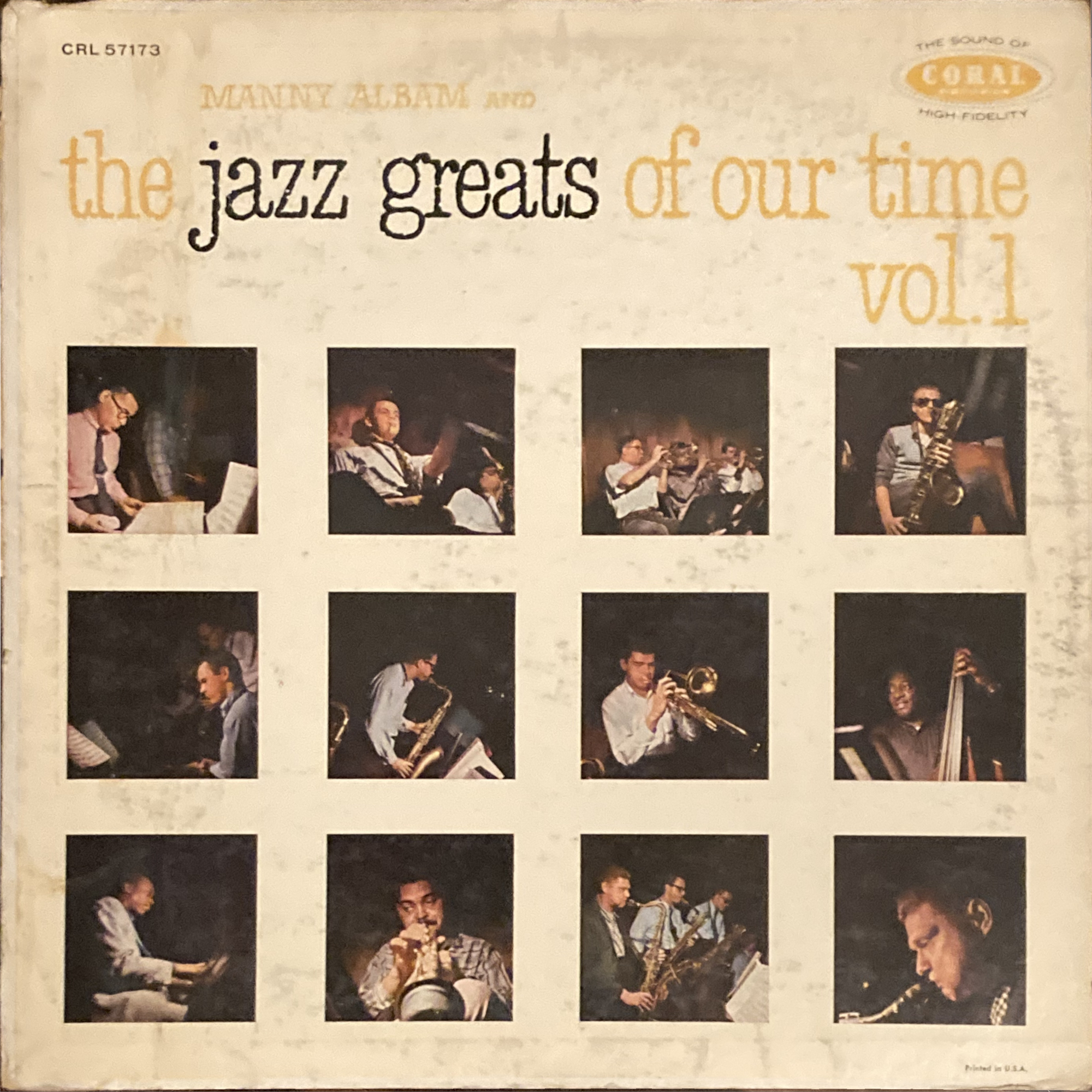
Label: CORAL RECORDS
No.: CRL 57173
Title: THE JAZZ GREATS OF OUR TIME
Musician: MANNY ALBAM
Recorded: 1957
Monaural
Cover address: None
Laminate Coating
Flat Edge
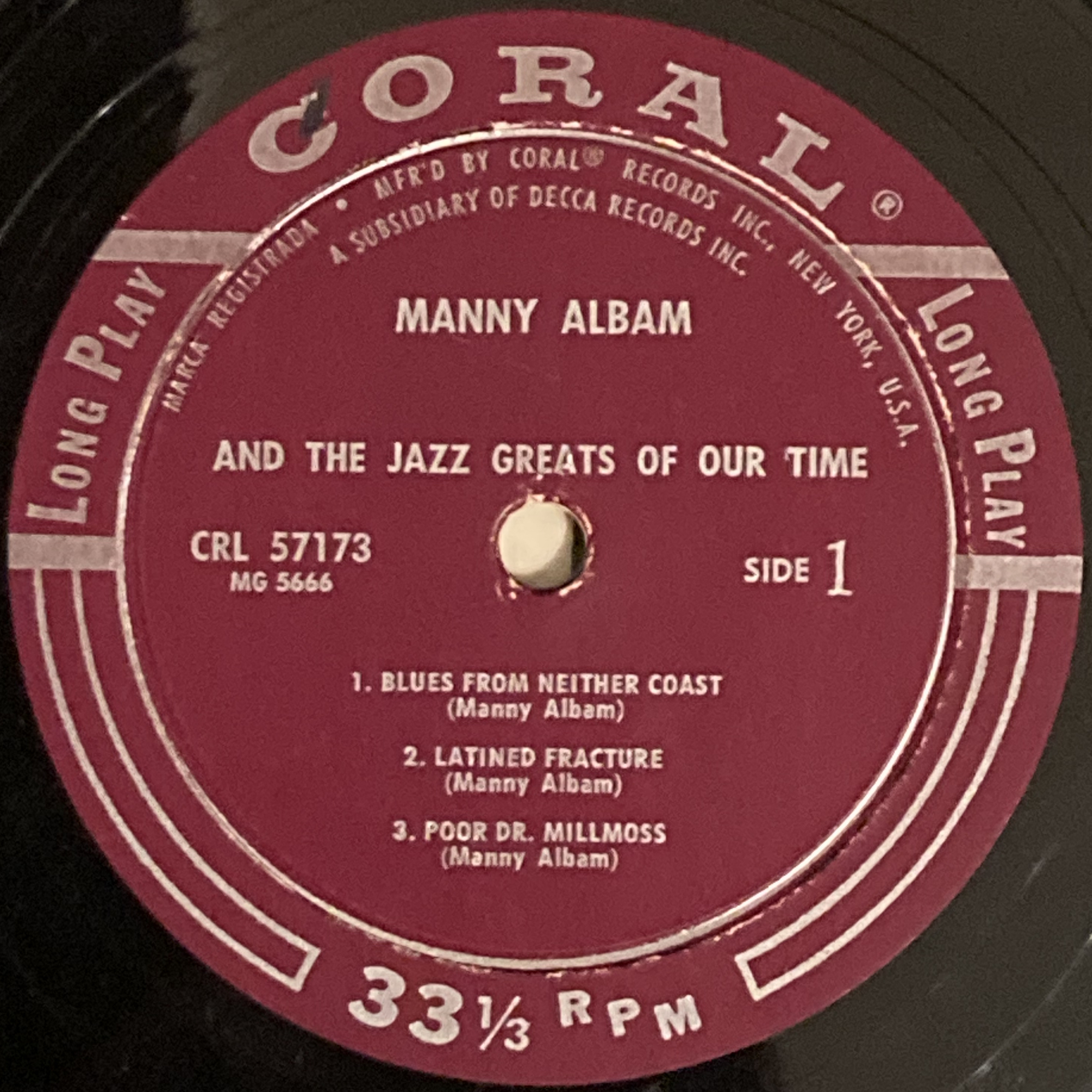
Label Side-1
Maroon Background
Silver Letter
Address: NEW YORK, U.S.A.
Deep Groove
Dead Wax Info: MG 5666T3, IP
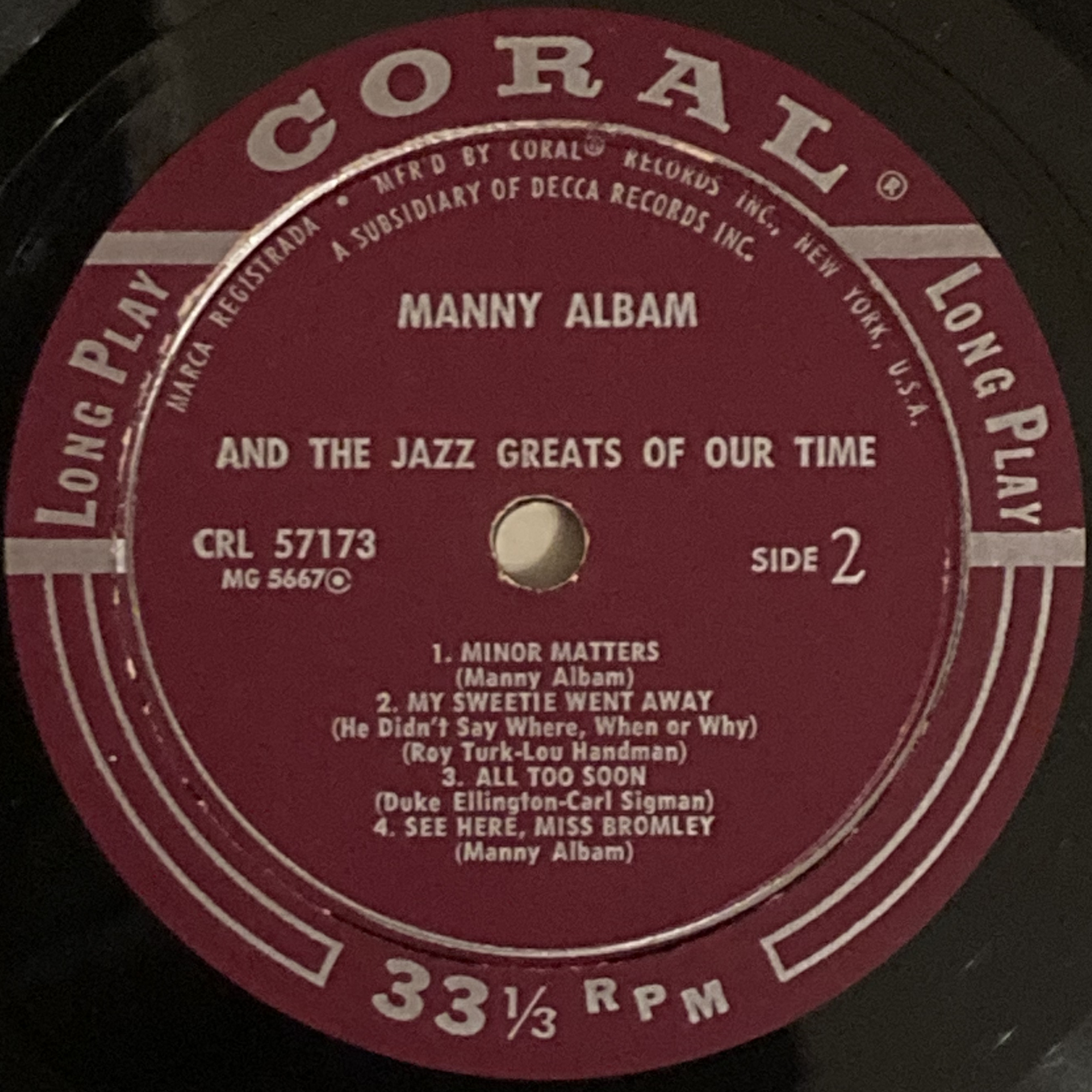
Label Side-2
Maroon Background
Silver Letter
Address: NEW YORK, U.S.A.
Deep Groove
Dead Wax Info: MG 5667T2, IP
Personnel-
Drums: Osie Johnson
Bass: Milt Hinton
Piano: Hank Jones
Tenor Sax: Al Cohn, Zoot Sims
Alto Sax: Phil Woods
Baritone Sax: Gerry Mulligan
Trumpet: Nick Travis, Art Farmer
Valve Trombone: Bob Brookmeyer
Tracks-
Side-1
1) Blues from Neither
2) Coast
3) Latined Fracture
4) Poor Dr. Millmoss
Side-2
1) Minor Matters
2) My Sweetie Went Away (Hw Didn’t Say Where, When or Why)
3) All Too Soon
4) See Here, Miss Bromley
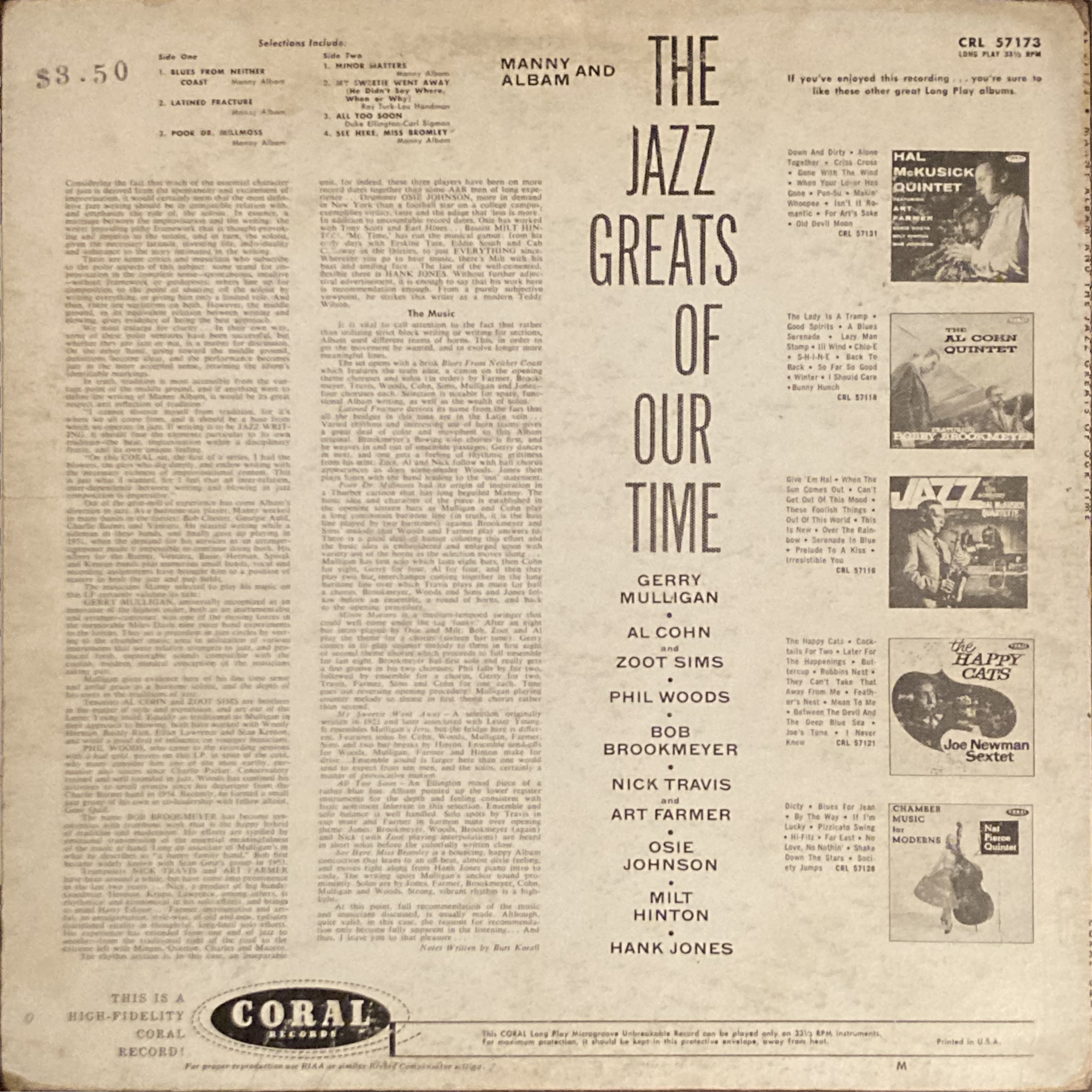
<裏ジャケ原文>
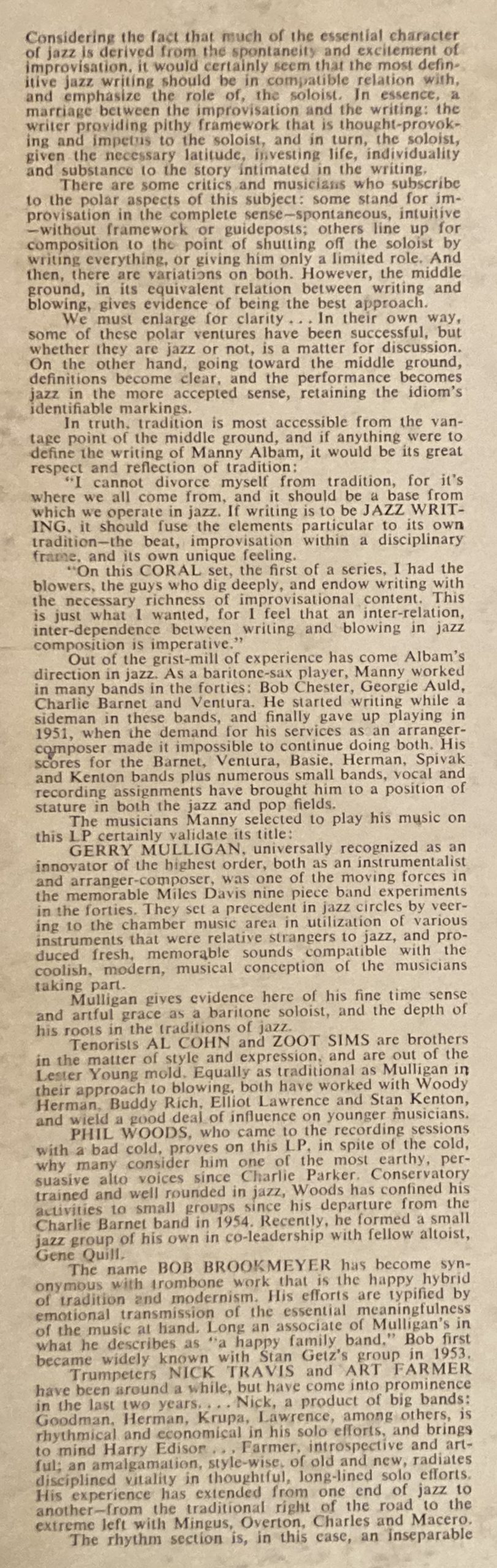
Considering the fact that much of the essential character of jazz is derived from the spontaneity and excitement of improvisation, it would certainly seem that the most defin- itive jazz writing should be in compatible relation with, and emphasize the role of, the soloist. In essence, a marriage between the improvisation and the writing: the writer providing pithy framework that is thought-provok- ing and impetus to the soloist, and in turn, the soloist, given the necessary latitude, investing life, individuality and substance to the story intimated in the writing,
There are some critics and musicians who subscribe to the polar aspects of this subject: some stand for im- provisation in the complete sense-spontaneous, intuitive -without framework or guideposts; others line up for composition to the point of shutting off the soloist by writing everything, or giving him only a limited role. And then, there are variations on both. However, the middle ground, in its equivalent relation between writing and blowing, gives evidence of being the best approach.
We must enlarge for clarity… In their own way, some of these polar ventures have been successful, but whether they are jazz or not, is a matter for discussion. On the other hand, going toward the middle ground, definitions become clear, and the performance becomes jazz in the more accepted sense, retaining the idiom’s identifiable markings.
In truth, tradition is most accessible from the van- tage point of the middle ground, and if anything were to define the writing of Manny Albam, it would be its great respect and reflection of tradition:
“I cannot divorce myself from tradition, for it’s where we all come from, and it should be a base from which we operate in jazz. If writing is to be JAZZ WRIT- ING, it should fuse the elements particular to its own tradition-the beat, improvisation within a disciplinary frame, and its own unique feeling.
“On this CORAL set, the first of a series, I had the blowers, the guys who dig deeply, and endow writing with the necessary richness of improvisational content. This is just what I wanted, for I feel that an inter-relation, inter-dependence between writing and blowing in jazz composition is imperative.”
Out of the grist-mill of experience has come Albam’s direction in jazz. As a baritone-sax player, Manny worked in many bands in the forties: Bob Chester, Georgie Auld, Charlie Barnet and Ventura. He started writing while a sideman in these bands, and finally gave up playing in 1951, when the demand for his services as an arranger- composer made it impossible to continue doing both. His scores for the Barnet, Ventura, Basie, Herman, Spivak and Kenton bands plus numerous small bands, vocal and recording assignments have brought him to a position of stature in both the jazz and pop fields.
The musicians Manny selected to play his music on this LP certainly validate its title:
GERRY MULLIGAN, universally recognized as an innovator of the highest order, both as an instrumentalist and arranger-composer, was one of the moving forces in the memorable Miles Davis nine piece band experiments in the forties. They set a precedent in jazz circles by veer- ing to the chamber music area in utilization of various instruments that were relative strangers to jazz, and pro- duced fresh, memorable sounds compatible with the coolish, modern, musical conception of the musicians taking part.
Mulligan gives evidence here of his fine time sense and artful grace as a baritone soloist, and the depth of his roots in the traditions of jazz.
Tenorists AL COHN and ZOOT SIMS are brothers in the matter of style and expression, and are out of the Lester Young mold. Equally as traditional as Mulligan in their approach to blowing, both have worked with Woody Herman, Buddy Rich, Elliot Lawrence and Stan Kenton, and wield a good deal of influence on younger musicians.
PHIL WOODS, who came to the recording sessions with a bad cold, proves on this LP, in spite of the cold, why many consider him one of the most earthy, per- suasive alto voices since Charlie Parker. Conservatory trained and well rounded in jazz, Woods has confined his activities to small groups since his departure from the Charlie Barnet band in 1954. Recently, he formed a small jazz group of his own in co-leadership with fellow altoist, Gene Quill.
The name BOB BROOKMEYER has become syn- onymous with trombone work that is the happy hybrid of tradition and modernism. His efforts are typified by emotional transmission of the essential meaningfulness of the music at hand. Long an associate of Mulligan’s in what he describes as “a happy family band.” Bob first became widely known with Stan Getz’s group in 1953.
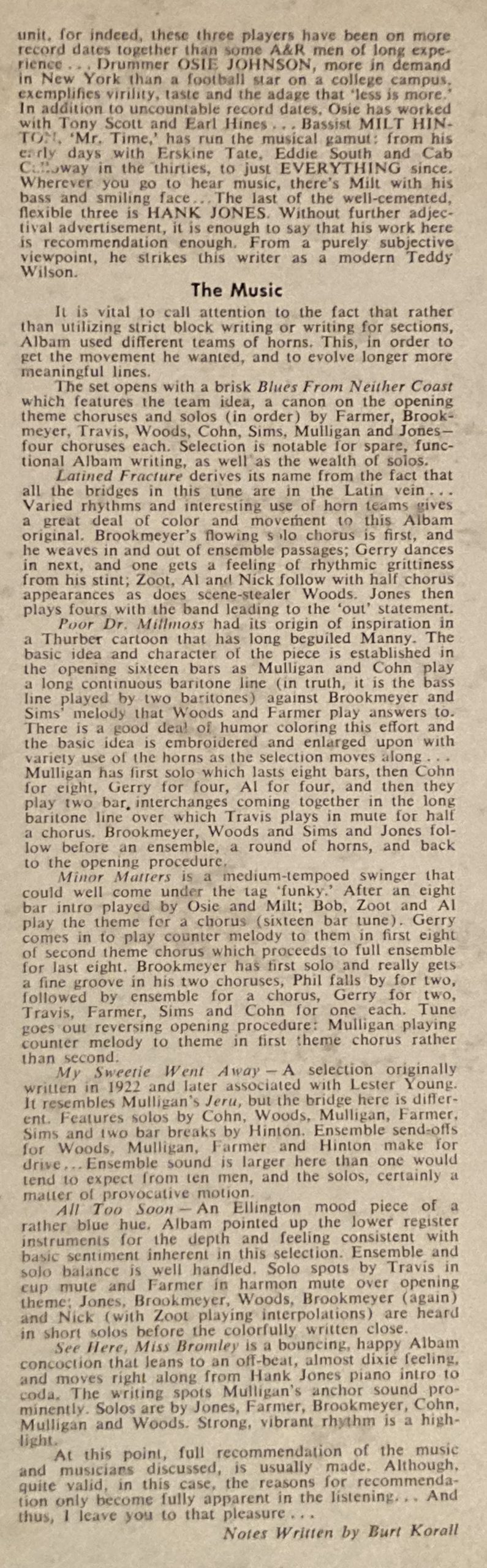
Trumpeters NICK TRAVIS and ART FARMER have been around a while, but have come into prominence in the last two years…. Nick, a product of big bands: Goodman, Herman, Krupa, Lawrence, among others, is rhythmical and economical in his solo efforts, and brings to mind Harry Edisor… Farmer, introspective and art- ful; an amalgamation, style-wise, of old and new, radiates disciplined vitality in thoughtful, long-lined solo efforts. His experience has extended from one end of jazz to another-from the traditional right of the road to the extreme left with Mingus, Overton, Charles and Macero. The rhythm section is, in this case, an inseparable unit, for indeed, these three players have been on more record dates together than some A&R men of long expe- rience… Drummer OSIE JOHNSON, more in demand in New York than a football star on a college campus, exemplifies virility, taste and the adage that ‘less is more. In addition to uncountable record dates, Osie has worked with Tony Scott and Earl Hines… Bassist MILT HIN- TON, ‘Mr. Time,’ has run the musical gamut: from his early days with Erskine Tate, Eddie South and Cab Coway in the thirties, to just EVERYTHING since. Wherever you go to hear music, there’s Milt with his bass and smiling face… The last of the well-cemented, flexible three is HANK JONES. Without further adjec- tival advertisement, it is enough to say that his work here is recommendation enough. From a purely subjective viewpoint, he strikes this writer as a modern Teddy Wilson.
The Music
It is vital to call attention to the fact that rather than utilizing strict block writing or writing for sections, Albam used different teams of horns. This, in order to get the movement he wanted, and to evolve longer more meaningful lines.
The set opens with a brisk Blues From Neither Coast which features the team idea, a canon on the opening theme choruses and solos (in order) by Farmer, Brook- meyer, Travis, Woods, Cohn, Sims, Mulligan and Jones- four choruses each. Selection is notable for spare, func- tional Albam writing, as well as the wealth of solos.
Latined Fracture derives its name from the fact that all the bridges in this tune are in the Latin vein… Varied rhythms and interesting use of horn teams gives a great deal of color and movement to this Albam original. Brookmeyer’s flowing solo chorus is first, and he weaves in and out of ensemble passages; Gerry dances in next, and one gets a feeling of rhythmic grittiness from his stint; Zoot, Al and Nick follow with half chorus appearances as does scene-stealer Woods. Jones then plays fours with the band leading to the ‘out’ statement.
Poor Dr. Millmoss had its origin of inspiration in a Thurber cartoon that has long beguiled Manny. The basic idea and character of the piece is established in the opening sixteen bars as Mulligan and Cohn play a long continuous baritone line (in truth, it is the bass line played by two baritones) against Brookmeyer and Sims’ melody that Woods and Farmer play answers to. There is a good deal of humor coloring this effort and the basic idea is embroidered and enlarged upon with variety use of the horns as the selection moves along. Mulligan has first solo which lasts eight bars, then Cohn for eight, Gerry for four, Al for four, and then they play two bar, interchanges coming together in the long baritone line over which Travis plays in mute for half a chorus. Brookmeyer, Woods and Sims and Jones fol- low before an ensemble, a round of horns, and back to the opening procedure.
Minor Matters is a medium-tempoed swinger that could well come under the tag ‘funky.’ After an eight bar intro played by Osie and Milt; Bob, Zoot and Al play the theme for a chorus (sixteen bar tune), Gerry comes in to play counter melody to them in first eight of second theme chorus which proceeds to full ensemble for last eight. Brookmeyer has first solo and really gets a fine groove in his two choruses, Phil falls by for two, followed by ensemble for a chorus, Gerry for two, Travis, Farmer, Sims and Cohn for one each. Tune goes out reversing opening procedure: Mulligan playing counter melody to theme in first theme chorus rather than second.
My Sweetie Went Away A selection originally written in 1922 and later associated with Lester Young. It resembles Mulligan’s Jeru, but the bridge here is differ- ent. Features solos by Cohn, Woods, Mulligan, Farmer, Sims and two bar breaks by Hinton. Ensemble send-offs for Woods, Mulligan, Farmer and Hinton make for drive… Ensemble sound is larger here than one would tend to expect from ten men, and the solos, certainly a matter of provocative motion.
All Too Soon – An Ellington mood piece of a rather blue hue. Albam pointed up the lower register instruments for the depth and feeling consistent with basic sentiment inherent in this selection. Ensemble and solo balance is well handled. Solo spots by Travis in cup mute and Farmer in harmon mute over opening theme; Jones, Brookmeyer, Woods, Brookmeyer (again) and Nick (with Zoot playing interpolations) are heard in short solos before the colorfully written close.
See Here, Miss Bromley is a bouncing, happy Albam concoction that leans to an off-beat, almost dixie feeling, and moves right along from Hank Jones piano intro to coda. The writing spots Mulligan’s anchor sound pro- minently. Solos are by Jones, Farmer, Brookmeyer, Cohn, Mulligan and Woods. Strong, vibrant rhythm is a high- light.
At this point, full recommendation of the music and musicians discussed, is usually made. Although, quite valid, in this case, the reasons for recommenda- tion only become fully apparent in the listening… And thus, I leave you to that pleasure…
Notes Written by Burt Korall
<裏ジャケ和訳>
ジャズの本質的な性格の多くが、即興演奏(インプロヴィゼーション)の自発性と興奮に由来していることを考えれば、ジャズにおける最も決定的な「作曲・編曲(ライティング)」とは、ソリストと調和し、その役割を際立たせるものであるべきだと言えるだろう。つまり、即興演奏と作曲・編曲の幸福な結合である。作曲家は、ソリストの思考を刺激し、演奏の推進力となるような簡潔かつ核心を突いた枠組みを提供する。一方、ソリストは、与えられた自由な空間の中で、その枠組みが示唆する物語に命を吹き込み、個性を与え、実体をもたらすのである。
この問題に対しては、両極端な立場をとる批評家やミュージシャンも存在する。一方には、枠組みや指針を一切排除した、完全かつ直感的で自発的な即興演奏を重視する人々がいる。もう一方には、作曲・編曲を徹底し、ソリストの役割を極端に制限したり、あるいは完全に排除したりする人々がいる。もちろん、その中間には様々なバリエーションも存在する。しかし、作曲・編曲と即興演奏が対等な関係にある「中道」こそが、最良のアプローチであると言える。
もう少し詳しく説明しよう。こうした極端な試みも、それぞれ独自のやり方で成功を収めてはいるかもしれないが、それらが果たして「ジャズ」と呼べるかどうかは議論の余地がある。対照的に、中道のアプローチをとれば、ジャズの定義は明確になり、演奏はより一般的に受け入れられる「ジャズ」の形となる。つまり、ジャズという様式特有の識別可能な特徴がしっかりと保持されるのである。
実のところ、ジャズの伝統に最も深く触れられるのは、この「中道」という視点からである。マニー・アルバムの作曲・編曲を特徴づけるものがあるとすれば、それは伝統に対する深い敬意と、それを作品に反映させる姿勢だろう。
「私は伝統から離れることはできない。なぜなら、私たちは皆、そこから生まれてきたからだ。ジャズにおいて、伝統は私たちが活動するための基盤であるべきだ。もし作曲・編曲が『ジャズのためのもの』であるならば、それはジャズ独自の伝統――ビート、規律ある枠組みの中での即興演奏、そしてジャズ特有のフィーリング――を融合させたものであるべきだ」
「シリーズの第一弾となるこの『コーラル(CORAL)』レーベルでの作品では、私は『深く掘り下げることができる』奏者たちを起用した。彼らは、作曲・編曲に、即興演奏ならではの豊かな内容を吹き込んでくれたのだ」 「これこそ私が求めていたものです。ジャズの作曲において、譜面に書くことと実際に演奏することの間には、相互の関連性や依存関係が不可欠だと考えているからです。」
マニー・アルバムのジャズにおける方向性は、彼が積み重ねてきた数多くの経験から形作られたものです。1940年代、バリトン・サックス奏者だったマニーは、ボブ・チェスター、ジョージー・オールド、チャーリー・バーネット、ベンチュラといったバンドを渡り歩きました。そうしたバンドでサイドマンを務める傍ら、彼は作曲も手がけるようになり、1951年には演奏活動から完全に身を引くことになります。アレンジャー兼作曲家としての需要が高まり、演奏と作曲の両立が困難になったためです。バーネット、ベンチュラ、ベイシー、ハーマン、スピヴァク、ケントンといったバンドのほか、数多くの小編成バンド、ボーカル作品、レコーディングの仕事を通じて、彼はジャズ界のみならずポップス界においても確固たる地位を築き上げました。
本作(LP)でマニーが自身の楽曲を演奏するために選んだミュージシャンたちは、まさにアルバム・タイトルの正当性を証明しています。
ジェリー・マリガンは、楽器奏者としてもアレンジャー兼作曲家としても最高水準の革新者として広く認められており、1940年代に行われたマイルス・デイヴィスの歴史的な9人編成バンドの実験において、中心的な役割を果たした人物の一人です。彼らは、それまでジャズではあまり使われていなかった楽器を導入し、室内楽的なアプローチを取り入れることでジャズ界に新たな先例を作りました。そして、参加したミュージシャンたちが抱いていたクールでモダンな音楽的構想と調和する、新鮮で記憶に残るサウンドを生み出したのです。
本作においてマリガンは、バリトン・サックスのソリストとして、優れたタイム感と巧みな優雅さを発揮しており、ジャズの伝統に深く根ざした音楽性を見せつけています。
テナー・サックス奏者のアル・コーンとズート・シムズは、スタイルや表現の面で兄弟のような関係にあり、レスター・ヤングの系譜を継ぐ存在です。マリガンと同様、伝統を重んじるアプローチで演奏する彼らは、ウディ・ハーマン、バディ・リッチ、エリオット・ローレンス、スタン・ケントンらのバンドで活躍し、若いミュージシャンたちに多大な影響を与えてきました。
レコーディング・セッションにひどい風邪を引いた状態で臨んだフィル・ウッズですが、本作では、その体調不良を感じさせない演奏を披露しています。彼がなぜチャーリー・パーカー以降、最も人間味に溢れ、説得力のあるアルト・サックス奏者の一人と見なされているのか、その理由がここにはっきりと示されています。ジャズにおいて十分な訓練を積み、幅広い素養を備えたウッズは、1954年にチャーリー・バーネット楽団を離れて以来、小編成のグループを中心に活動してきた。最近では、同じアルト・サックス奏者であるジーン・クイルと共同リーダーを務める形で、自身のジャズ・グループを結成した。
ボブ・ブルックマイヤーという名は、伝統とモダニズムを幸福に融合させたトロンボーン演奏の代名詞となっている。彼の音楽活動の大きな特徴は、演奏する楽曲が本来持つ深い意味を、感情を込めて聴き手に伝える点にある。ジェリー・マリガンのグループで長年活動し、その関係を「幸せな家族のようなバンド」と表現しているボブが広く知られるようになったのは、1953年、スタン・ゲッツのグループに参加した時のことである。
トランペット奏者のニック・トラヴィスとアート・ファーマーは、以前から活動してはいたものの、ここ2年ほどで一気に注目を集めるようになった。ニックは、ベニー・グッドマン、ウディ・ハーマン、ジーン・クルーパ、エリオット・ローレンスといったビッグ・バンドでの経験を持ち、ソロではリズミカルかつ無駄のない演奏を披露する。その姿はハリー・エディソンを彷彿とさせる。一方、内省的で巧みなアート・ファーマーは、新旧のスタイルを融合させたような音楽性を持ち、思慮深く、長いフレージングのソロの中に、規律ある活力を見せている。彼のキャリアはジャズの全領域に及んでおり、伝統的なスタイルから、チャールズ・ミンガス、フランク・オーヴァートン、テディ・チャールズ、テオ・マセロらとの前衛的な試みに至るまで、実に幅広い。本作のリズム・セクションは、極めて強固に結びついた一体となっており、それもそのはず、この3人は、長年経験を積んだA&R担当者でさえ驚くほどの回数、レコーディングで共演を重ねてきた仲なのだ。ドラマーのオジー・ジョンソンは、ニューヨークの音楽シーンにおいて、大学キャンパスのフットボール・スター以上に引っ張りだこの存在であり、力強さとセンス、そして「少ないほど豊かである(less is more)」という格言を体現するようなプレイを見せる。彼は数え切れないほどのレコーディングに参加してきたほか、トニー・スコットやアール・ハインズとも共演している。ベーシストのミルト・ヒントンは「ミスター・タイム」の異名を取り、1930年代のアースキン・テイト、エディ・サウス、キャブ・キャロウェイとの活動から始まり、それ以降、あらゆる音楽の現場を経験してきた。どこへ音楽を聴きに行っても、そこには必ずベースを抱えたミルトの笑顔がある。そして、この強固かつ柔軟なトリオの最後の一人がハンク・ジョーンズだ。彼については、あえて多くの形容詞を並べるまでもない。本作での演奏を聴けば、それだけで彼の素晴らしさが十分に伝わるはずだ。個人的な見解を言わせてもらえば、彼は「現代のテディ・ウィルソン」といったところだろう。
音楽について
特筆すべきは、アラン・アルバムが、厳格なブロック・コードやセクション単位の編曲に頼るのではなく、ホーン奏者たちを様々な組み合わせのグループに分けて起用している点である。これは、彼が意図した動きを生み出し、より長く、意味深いフレージングを展開させるための手法である。このセットは、軽快な「ブルース・フロム・ネイザー・コースト(Blues From Neither Coast)」で幕を開ける。ここでのコンセプトは、冒頭のテーマ・コーラスをカノン形式で展開するというものだ。続いてファーマー、ブルックマイヤー、トラヴィス、ウッズ、コーン、シムズ、マリガン、ジョーンズの順でソロが披露され、各人4コーラスずつを担当している。本作は、アルバム(マニー・アルバム)による無駄を削ぎ落とした機能的なアレンジと、数多くのソロが聴きどころとなっている。
「ラティンド・フラクチャー(Latined Fracture)」という曲名は、楽曲内のすべてのブリッジ(中間部)がラテン調であることに由来している。多彩なリズムとホーン・セクションの巧みな活用が、アルバムによるこのオリジナル曲に豊かな色彩と躍動感を与えている。まずはブルックマイヤーが流麗なソロを披露し、アンサンブルの合間を縫うように演奏を展開する。続いてジェリー(・マリガン)が登場し、そのプレイからはリズムの力強い手触りが感じられる。その後、ズート、アル、ニックがそれぞれハーフ・コーラスのソロをとり、ひときわ存在感を放つウッズもそれに続く。続いてジョーンズがバンドと4小節交換(フォア・バーズ)を行い、そのままエンディングのテーマへと突入する。
「プア・ドクター・ミルモス(Poor Dr. Millmoss)」は、以前からマニー(・アルバム)を魅了してきたサーバー(ジェームズ・サーバー)の漫画から着想を得た作品である。冒頭の16小節で楽曲の基本コンセプトと性格が提示される。マリガンとコーンが(実際には2本のバリトン・サックスでベース・ラインを演奏する形で)長く続くバリトン・ラインを奏でる一方、ブルックマイヤーとシムズがメロディを提示し、それに対してウッズとファーマーが応答する。全体にユーモアが漂うこの曲では、ホーン楽器が多彩に駆使されることで、基本的なアイデアが発展・拡大されていく。ソロはマリガン(8小節)、コーン(8小節)、ジェリー(4小節)、アル(4小節)と続き、その後2小節交換へと移行する。その間、バリトン・サックスによる長いラインが維持され、その上でトラヴィスがミュートをつけた楽器でハーフ・コーラスのソロを奏でる。続いてブルックマイヤー、ウッズ、シムズ、ジョーンズがソロをとり、アンサンブルを経てホーンの掛け合いがあり、冒頭の構成へと戻る。
「マイナー・マターズ(Minor Matters)」はミディアム・テンポのスウィング・ナンバーで、「ファンキー」という言葉がぴったりの楽曲だ。オーシー(・ジョンソン)とミルト(・ヒントン)による8小節のイントロの後……ボブ、ズート、アルがテーマを1コーラス(16小節の楽曲)演奏し、続くコーラスの最初の8小節でジェリーがカウンター・メロディを加えて加わります。後半の8小節はフル・アンサンブルとなります。最初のソロはブルックマイヤーが担当し、2コーラスにわたって見事なグルーヴを聴かせます。続いてフィルが2コーラス、アンサンブルが1コーラス、ジェリーが2コーラスを担当し、その後トラヴィス、ファーマー、シムズ、コーンがそれぞれ1コーラスずつソロをとります。曲の締めくくりは冒頭の構成を逆にした形となっており、ジェリー・マリガンが(冒頭とは異なり)最初のコーラスでテーマに対するカウンター・メロディを演奏します。
「マイ・スウィーティ・ウェント・アウェイ(My Sweetie Went Away)」は1922年に書かれた楽曲で、後にレスター・ヤングゆかりのナンバーとして知られるようになりました。マリガンの「ジェル(Jeru)」に似た雰囲気がありますが、ブリッジ部分は異なります。コーン、ウッズ、マリガン、ファーマー、シムズによるソロがフィーチャーされ、ヒントンが2小節のブレイクを挟みます。ウッズ、マリガン、ファーマー、ヒントンのソロの前後にはアンサンブルによる「送り(センド・オフ)」が入り、演奏に推進力を与えています。10人編成という規模から想像されるよりもアンサンブルのサウンドは重厚で、各ソロも刺激的で躍動感に満ちています。
「All Too Soon」は、エリントン作の、どこか憂いを帯びたムードあふれる楽曲だ。アラン・アルバム(編曲者)は、この曲の根底にある感情にふさわしい深みと情緒を引き出すため、低音域の楽器を際立たせている。アンサンブルとソロのバランスも巧みだ。冒頭のテーマでは、トラヴィスがカップ・ミュートを、ファーマーがハーマン・ミュートをつけたトランペットでソロを披露する。その後、ジョーンズ、ブルックマイヤー、ウッズ、再びブルックマイヤー、そしてニック(ズートが合いの手を入れる)による短いソロが続き、色彩豊かなエンディングへと向かう。
「See Here, Miss Bromley」は、アルバムが手がけた、弾むように陽気なナンバーだ。オフビートを効かせた、どこかディキシーランド・ジャズを彷彿とさせる雰囲気があり、ハンク・ジョーンズのピアノ・イントロからコーダまで、軽快に展開していく。編曲では、マリガンの奏でる重厚なサウンドが重要な役割を果たしている。ソロをとるのは、ジョーンズ、ファーマー、ブルックマイヤー、コーン、マリガン、そしてウッズ。力強く躍動感あふれるリズムが聴きどころだ。
ここで、取り上げた音楽とミュージシャンを全面的に推薦したいところだが、その理由は実際に聴いてみて初めて、心から納得できるものだろう。……というわけで、あとは皆さんがこの音楽を存分に楽しんでくれることを願う。
ライナーノーツ執筆:バート・コラル
※訳文の制作にはGoogleドライブとGoogle翻訳のお世話になりました。

コメント